
Citroën DS
A brief history and gallery of the Citroën DS.
Beginning of the Citroën DS.
Originally conceived as a successor to the Citroën Traction Avant, the Citroën DS was created through the collaboration of Italian industrial designer and sculptor Flaminio Bertoni and French aeronautical engineer André Lefèbvre. Its revolutionary hydropneumatic suspension system was developed by Paul Magès, giving the car its signature ride quality and self-levelling capability.
In 1967, the DS received a significant facelift designed by Robert Opron, which modernized its front-end styling while retaining its distinctive futuristic character.
The Generations of the Citroën DS.
The ID19 was a more affordable derivative of the Citroën DS, positioned as a simpler and less luxurious alternative. It was produced from 1957 to 1969. After its discontinuation, it was effectively succeeded by the D Spécial and D Super, which were produced from 1970 to 1975.
The DS underwent several styling and technical evolutions throughout its lifespan. The Series 2 update, introduced in 1962, featured a redesigned front end with improved aerodynamics, enhanced cooling and ventilation, and various mechanical refinements.
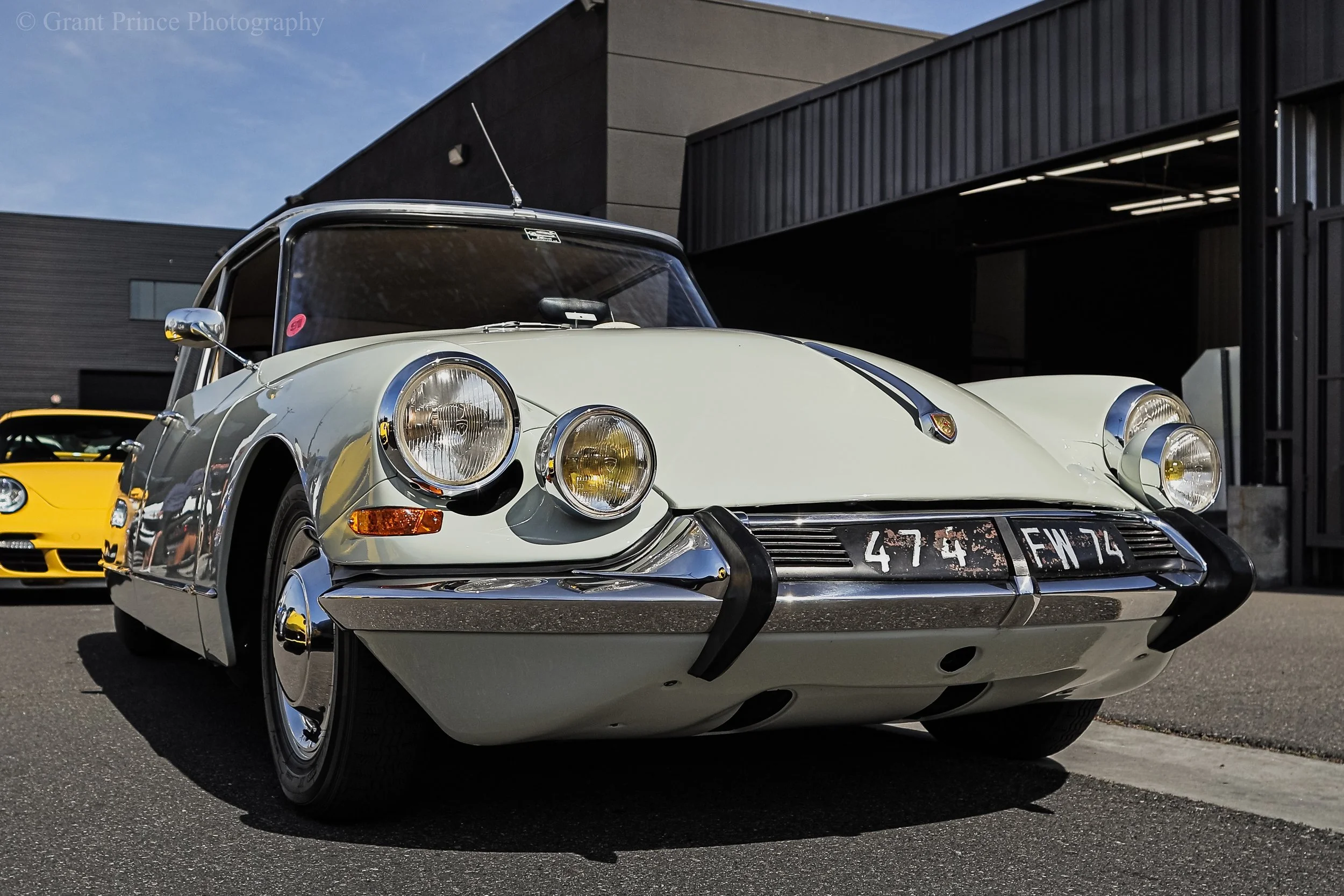
In 1967, the Series 3 facelift introduced one of the DS’s most distinctive features: four headlamps under glass covers, with the inner pair designed to swivel with steering input for improved night visibility. Due to U.S. regulations, a modified version without the glass covers and directional headlight function was also produced.
Multiple body styles and variants were offered over the years. The luxury-oriented Pallas model added upgraded interior materials and comfort features, while estate (station wagon) and ambulance versions expanded its practicality. A factory convertible was also produced.
In addition, several specialist and coachbuilt variants were created, including designs by Henri Chapron, the Bossaert coupé, and experimental models such as the Michelin PLR.
Interesting Details
The Citroën DS featured several innovative and unconventional design elements. One of its most notable systems was the advanced hydropneumatic suspension, which provided exceptional ride comfort and self-levelling capability. This system also allowed the car to maintain mobility with limited wheel contact in certain conditions, function as a built-in jack for wheel changes, and automatically lower the body when the engine was turned off.
Another distinctive design choice was the placement of the turn indicators on the roofline at the rear of the vehicle, improving visibility to surrounding traffic.
The DS also featured partially enclosed rear wheels, integrated into the bodywork to reduce aerodynamic drag while contributing to its streamlined, futuristic appearance.
Gallery
Sources:
“Citroën DS.” Wikipedia, https://en.wikipedia.org/wiki/Citro%C3%ABn_DS
